
Building Compliance FAQs
Form 12A & Inspection Outcomes
FAQ 1 Can a Form 12A be issued if defects are identified during inspection or testing?
Outstanding defects mean system performance has not been confirmed for that inspection period.
FAQ 2 Can a Form 12A be issued with notes stating defects exist?
Where defects remain, a defect report should be issued instead.
FAQ 3 Can defects remain open if they are fixed before BWOF expiry?
FAQ 4 Does it matter which inspection identified the defects?
Accurate records support annual review decisions and BWOF certification integrity.
Records should identify:
inspection date
inspection type or cycle
whether defects are isolated, recurring, or system-wide
FAQ 5 What actions are required when defects are identified?
Reasoning
Inspection outcomes must be transparent so owners understand impacts on certification.
Typical actions include:
- documenting defects
- notifying owner/agent
- explaining impact on Form 12A
- escalating life-safety concerns
- retaining communication records
FAQ 6 What if a tenant removes a specified system?
- advise the building owner or their representative of the issue
- document the situation in their reporting, including photos where appropriate
- explain the impact of the removal and any associated risks; and
- refer the matter back to the owner to resolve with Council.
Inspection Scope & Compliance Interpretation
FAQ 1 Is identifying defects the same as declaring a system non-compliant?
Construction compliance relates to design, installation, and consented works, which sit outside routine inspection scope.
FAQ 2 What if defects appear related to original design or installation?
Inspection does not reassess original construction compliance but may identify issues requiring further review.FAQ 2 description
FAQ 3 Who can sign the Form 12A for a CO₂ detection system?
If a building's Compliance Schedule lists the system as SS2.3, the person signing the Form 12A will generally need to be an IQP approved for SS2.3. In many cases, this approval is held by an alarm company rather than an HVAC company. An HVAC company may still do the actual work but liaise with the SS2 alarm IQP for final 12A sign off.
Annual Review & IQP Decisions
FAQ 1 What outcomes are available to an IQP at annual review?
Each outcome reflects inspection status at the time of review.
FAQ 2 Why do disputes commonly arise at BWOF time?
FAQ 3 SRaDs - What is an SRaD for?
What is the confusing part?
It is often the impact of the missed inspection that causes confusion. The SRaD should address what is affected because the inspection was missed - not become a general mechanism for recording building defects.
If required owner checks were missed and no Form 12A was issued, but the IQP inspection was completed and satisfactory, the issue is the missed owner inspection.Similarly, if two IQP inspections were required but only one was completed, the missed inspection may be addressed through an SRaD.
What should NOT be dealt with through an SRaD?
- Maintenance issue – deal with it as maintenance.
- Defect identified during an inspection but not fixed – the inspection occurred; manage the outstanding defect/remedial work.
- Construction or installation failure – deal with the building/construction issue.
- Incorrect Compliance Schedule frequency or performance standard – correct the Compliance Schedule.
The simple test:
Was the required inspection missed?
If yes, consider whether an SRaD is appropriate.
If no, deal with the issue through the appropriate pathway - maintenance, defect remediation, construction, or Compliance Schedule correction.
Repairs, Maintenance & Consents
FAQ 1 When do repairs or replacements require a Building Consent or exemption?
Compliance Schedule Inclusion
FAQ 1 — Do extract systems need to be included on a Compliance Schedule?
Common inclusions: mechanical fresh-air systems systems involving cooling towers smoke or fire control components hazardous contaminant extraction (e.g. spray booths, fume cupboards, commercial kitchens) Simple extract fans used for general ventilation or housekeeping purposes may not require inclusion, depending on function and risk.
FAQ 2 — Does a standard split-system heat pump need to be on a Compliance Schedule?
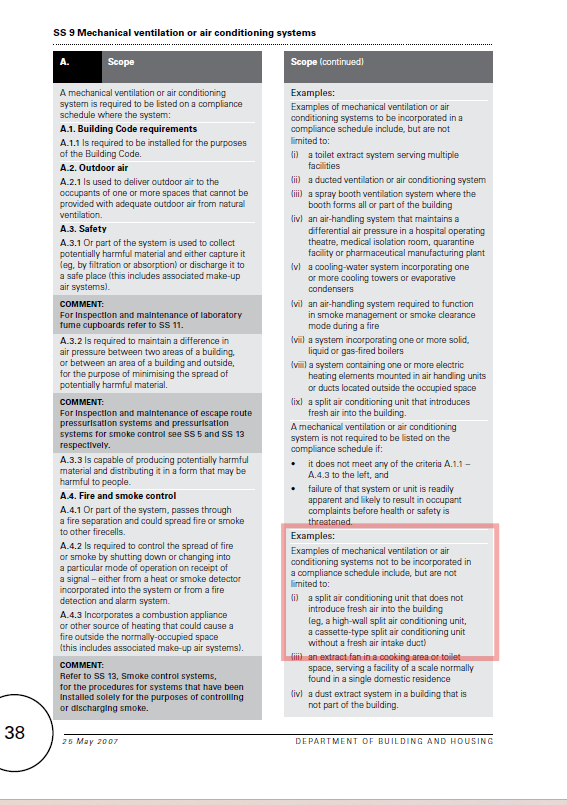
The Compliance Schedule Handbook specifically states that a split air conditioning unit that does not introduce fresh air into the building does not need to be included on a compliance schedule.
The key question is whether the system meets the definition of SS9 – Mechanical Ventilation or Air Conditioning. A typical split-system heat pump used for heating or cooling alone usually does not.
Form 12A & Compliance Schedule Scope
FAQ 1 – Can I issue a Form 12A if maintenance was not completed?
No.
A Form 12A confirms inspection, testing, and maintenance have been carried out.
If maintenance is incomplete, compliance cannot be certified for that period.
FAQ 2 - Can I fail a Form 12A because a room should have a system (in my opinion) but doesn’t?
No.
IQPs maintain existing specified systems. Installing new systems is a design issue and may require new building consent, not a Form 12A matter.
FAQ 3 - Am I responsible for upgrading systems to meet current Code?
FAQ 4 - If I take on a new site and notice a room that appears to need equipment that isn’t installed, does this affect my Form 12A?
FAQ 5 - Can I note and recommend that the absence of equipment be reviewed?
FAQ 6 - What if the Compliance Schedule is unclear about the equipment to service or the areas to inspect?
FAQ 7 - What if the Compliance Schedule lists equipment that does not exist in the building?
FAQ 8 - What if there is equipment in the building that is not listed on the Compliance Schedule?
FAQ 9 – Does an IQP inspect the means of escape?
Not in its entirety.
An IQP is responsible for the specified system they are engaged to inspect. For SS15/2 final exits, this means checking that the doors, hardware, panic furniture, self-closing devices, locking mechanisms and associated components operate as intended.
The broader means of escape—including how the building is managed during normal occupancy—is the responsibility of the building owner or occupier. Temporary obstructions, such as trolley barriers or chained aisles, are operational issues rather than defects with the specified system itself.
If an IQP observes an obstruction during an inspection, it should be reported to the building owner or person in charge so it can be rectified.
Technical
FAQ 1 What duration is required for emergency lighting?
FAQ 2 SS9 Inspection Frequencies
The traditional approach for SS9 has often been quarterly IQP inspections. But councils are increasingly looking at what the nominated standard actually requires.
AS/NZS 3666.2:2011 is an operation and maintenance standard with component-specific frequencies — including monthly, three-monthly and annual requirements.
For example, Dunedin City Council identifies:
- AS/NZS 3666.2:2011: monthly – filters; 3-monthly; annually
- AS 1851:2012 Section 13: monthly – kitchen exhausts and outdoor air intakes; 3-monthly; annually
The key point: The Standard may allow routine tasks, such as cleaning filters or exhausts, to be undertaken by the owner/tenant and recorded for the IQP to review. The service team can then continue with its usual quarterly inspection, checking that the required monthly activities are being carried out and recorded.
SS9 IQPs should have access to the applicable Standard, check the version relevant to the age and type of equipment, and advise the owner/tenant what is required, what is acceptable, and who is responsible for each task